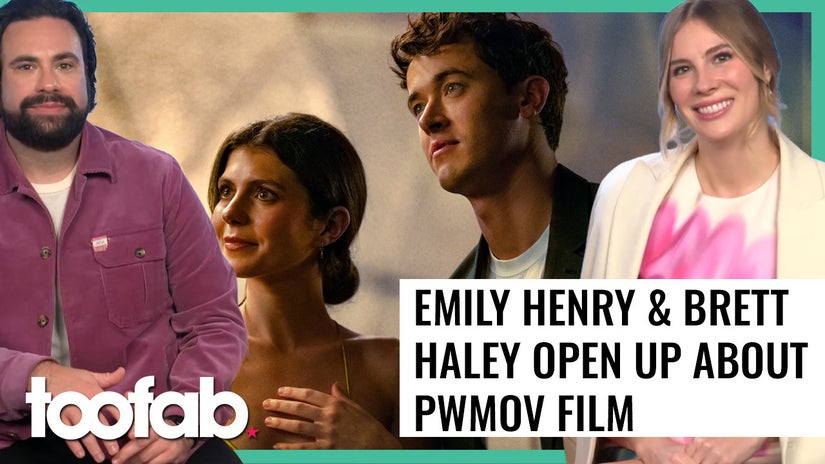
Author Emily Henry and director Brett Haley open up about bringing her bestseller to Netflix with stars Tom Blyth and Emily Bader, and how "misogyny" plays into Hollywood's belief romance adaptations aren't "money makers," despite "some of the greatest art ever written" being about love.
Bridgerton, Twilight, The Summer I Turned Pretty, and most recently, Heated Rivalry -- film and television adaptations of beloved romance novels aren't anything new. But despite the passionate fandoms behind the books, Hollywood still appears to find the often record-breaking successes of the adaptations as something shocking, rather than expected.
Author Emily Henry -- one of the top New York Times bestselling romance novelists -- has a simple explanation as to why.
"Misogyny is why, misogyny is why," Henry told TooFab's Paige Catton with a laugh at the virtual junket for the Netflix film adaptation of her 2021 novel, People We Meet on Vacation, alongside the romcom's director, Brett Haley.
Haley -- who has previously directed book adaptations All the Bright Places and Looking for Alaska -- expressed that female stories are "undervalued, plain and simple," and aren't seen as "money makers," which he stressed is "so untrue."
"It's an underserved audience, I think. I also think more men like romance than they'd like to admit," he explained. "I love romance, and I'm not scared to admit it, that those stories move me the most. I keep saying, these movies and these stories are about the biggest thing you can deal with, which is love, which is choosing someone, having someone choose you, loving yourself. These are epic. Some of the greatest art ever written has been about this thing."
"I think what we've done is we've put romcoms in a lower -- I'm gonna go on a rant -- a lower form of like, 'Oh, that's lesser than because it's a romcom,'" he continued. "And I think that that's unfair. And I think it's not right. I think that you need to put a lot of effort, and vision, and care into crafting a story like this."
"And I do think, like any movie -- there are great elevated horror films, and there are schlock horror films -- there's great elevated romance, and there's schlock romance, fluff romance," he added. "It's all about in the making of it. And I think when people see People We Meet on Vacation, they'll see the care that was put into it."
After Haley noted that Henry is "single-handedly helping the genre right now," the author humbly noted that "there are dozens of us, hundreds even," before pointing out that the overall conversation is something that's been prevalent in publishing "much longer than Hollywood."
"And you're absolutely right. It is hard to get people to listen and to believe that there's an audience for this," she asserted. "And you know, people talk about four-quadrant movies, which means, you know, everyone will go see them. But the thing about a four-quadrant movie, is it just is a movie men will go see. Like, women will go because women will go see any movie. You know what I mean?"
"There's so much ranting that could happen," she added.
The 34-year-old went on to bring up an even larger issue: why can't we love to watch movies or read books that make us happy?
"We don't prioritize joy in art the same way that we prioritize grief. I think we see grief, if you tell a story about grief, that's true art, or darkness, edge," Henry told TooFab. "I love a dark, edgy story. However, it is really hard to write a compelling story that's about joy. And when someone pulls that off, it's the best for me as an audience member or a reader, it's the best feeling in the world when someone can make you cry because you're so happy, or cheer. That is really hard to do. And to take these real-life things that feel huge in your real life -- love feels huge in your real life -- and to make that feel epic to a person who's not actually experiencing it for some reason, it is really hard."
Haley agreed, adding, "It's so hard to make a film that's joyful, that's earned, that actually makes people feel good, but in an earned way. I think people hear 'feel good movie' or 'it makes you feel good' and they go, 'That's fluff. That's not real.' No, that's the realest!"
"Why is that not important? Why is it not important to feel good?" Henry agreed, to which Haley emphasized that "we need it now" more than ever.
Waiting for your permission to load the Instagram Media.
"I think it, again, it has to be on the filmmaker and the writer to earn that. It isn't just, 'Oh, it's a romance, so it's great.' No, it needs to be earned, and it needs to be dealt with care, and a real vision," Haley continued, before again praising Henry. "And I think it starts with Emily. I think we carried that all the way through the shooting of this, and through post-production. You'll see every decision in this movie was thought out, and deeply, deeply obsessed about."
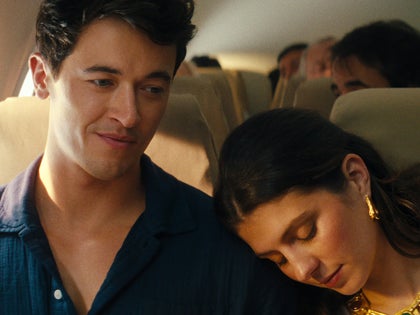
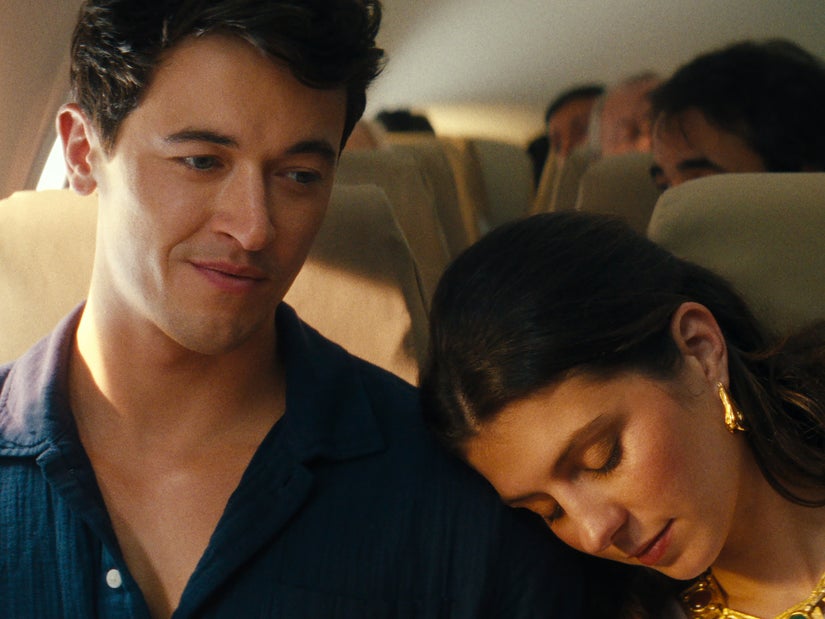
People We Meet on Vacation -- which is the first of five announced adaptations of Henry's bestselling romance novels -- follows, per Netflix, "free-spirited Poppy (Emily Bader) and routine-loving Alex (Tom Blyth), [who] have been unlikely best friends for a decade, living in different cities but spending every summer vacation together. The careful balance of their friendship is put to the test when they begin to question what has been obvious to everyone else -- could they actually be the perfect romantic match?"
Henry and Haley opened up to TooFab about their collaborative process, including how they navigated any challenges while bringing the former's novel to life.
"I mean, when rubber hits the road, and you've gotta go make a film practically, money does not grow on trees. You can't just say … we don't have a James Bond budget for this. I wish we did," Haley explained. "We had a sizable budget. We had everything that we needed to make this film. But there are practical elements to take into consideration, and it's about making sure that every time you're doing something, you are honoring the spirit of the book and you're honoring the characters, the beautiful characters that Emily wrote of Poppy and Alex. You have to stay true to that at every moment."
All Her Fault Author Andrea Mara Reveals Favorite Part About Adapting Her Work, Talks BookTok (Exclusive)
View Story"So, at every moment you could stop the film and say, 'This is a little bit different, but it's still the book. It is still the story that Emily wrote,' and, of course, that was a challenge, "he continued. "It took a lot of writers. It took a lot of thought, took a lot of me getting in the weeds; we got in the weeds so many times on this."
"We'd be, like, on the phone going through the script, just trying to rearrange things, trying to figure out what was broken," Henry chimed in. "And I really feel like, between you and all the writers, you nailed it. Nailed it."
"You have to find ways to be more efficient. It's just simply a different art form in a different medium in a different way of interacting with it," Haley added. "So you have to be smart, and you have to be efficient. So it is challenging, but it was a great fun sort of puzzle to break to make sure we got the spirit and the story fully there, just in a slightly different way. And we think the book is always gonna be there. And the book is the book, but this honors the book at every minute of the movie."
Henry pointed out how, in the novel, the reader is "literally in Poppy's head," as it's from her point of view, noting that it can be difficult to translate that on screen.
She also revealed that the "hardest thing" to adapt was the Croatia plot point. As book readers know, a vacation in Croatia gone wrong becomes a catalyst for Poppy and Alex becoming estranged for years. However, in the film, the events in Croatia occur during a previous trip in Tuscany, and play out a little bit differently.
Waiting for your permission to load the Instagram Media.
"I think the hardest thing to crack -- as far as what [Haley] brought to me -- there might have been other things that I didn't even know were struggles, but was the Croatia of it all, like Croatia is not in the movie," Henry explained. "And what happened in Croatia is not in the movie exactly ... There were all these reasons it just wasn't working. There were so many drafts where Croatia was in the movie or some version of it, and it was not working, and it took a really long time to kind of figure out why it didn't work."
"I think ultimately it was a thing of like, you're not in Poppy's head for all of this ... you need something more external to get you there. And you cracked it. It's great," she told Haley, who replied, "We could have done a version where we voiceover the whole film, but that didn't feel like the language of this movie."
"No!" Henry interjected, shaking her head, before noting that they had to figure out "how to communicate the same big feelings without going into [Poppy's] psyche."
The creative decisions ultimately paid off -- at least we think so -- and the film will surely be something book lovers and non-readers will enjoy.
In addition to Blyth and Bader, People We Meet on Vacation also stars Sarah Catherine Hook, Lucien Laviscount, Miles Heizer, Jameela Jamil, Tommy Do, Lukas Gage, Alice Lee, Molly Shannon, and Alan Ruck.
People We Meet on Vacation hits Netflix on January 9, 2026.